Skip to programme

ICSC 2026 · Oxford

Conference programme

Wednesday, 2 September to Friday, 4 September 2026 at Nuffield College, University of Oxford.

Time zone

All times are British Summer Time (BST, UTC+1).

Online access

Available only where explicitly marked in the programme.

Programme status

Updated ; final programme.

Pre-conference workshop

A full day of practical training at Nuffield College. Workshop sessions are in person only.

Workshop programme

In-person attendance only
  1. to

    Workshop registration

    Room: Nuffield College Porters' Lodge

  2. to

    Transformer Architectures I

    Led by Germans Savcisens. 1 hour 45 minutes

    Room: Main Lecture Theatre

    Teaching material for Transformer Architectures I

  3. to

    Break

    Room: Main Lecture Theatre Foyer

  4. to

    Transformer Architectures II

    Led by Germans Savcisens. 2 hours

    Room: Main Lecture Theatre

    Teaching material for Transformer Architectures II

  5. to

    Lunch and late registration

    Room: Junior Common Room

  6. to

    Non-visual data science and accessibility of scientific research outputs

    Led by Sophie Johanning (Silta). 1 hour

    Room: Main Lecture Theatre

    Teaching material for Non-visual data science and accessibility of scientific research outputs

  7. to

    Sequence Analysis and Sequenzo

    Led by Yuqi Liang. 1 hour

    Room: Main Lecture Theatre

    Teaching material for Sequence Analysis and Sequenzo

  8. to

    Break

    Room: Junior Common Room

  9. to

    An Introduction to OpenAlex

    Led by Charlie Rahal. 1 hour

    Room: Main Lecture Theatre

    Teaching material for An Introduction to OpenAlex

  10. to

    Multiverse Analysis with RobustiPy

    Led by Daniel Valdenegro. 1 hour

    Room: Main Lecture Theatre

Parallel programme

Editorial board meetings

Chester Room · Invitation only · Online option available

  1. to

    Joint Journal of Social Computing and ACM Transactions on Social Computing Editorial Board Meeting

Conference day one

Keynotes, special sessions, parallel research tracks, posters and the conference dinner.

Morning

Arrivals and setup

  1. to
    Registration

    Room: Nuffield College Porters' Lodge

  2. to
    Poster setup

    Room: Fellows' Garden

Welcome and opening keynotes

Room
Main Lecture Theatre
Online attendance available
  1. to
    Welcome to day one of ICSC 2026

    Presented by Charles Rahal

    Chaired by Charles Rahal

  2. to
    From Online Traces to Material Imprints: Articulating a Vision for Planetary Social Computing

    Presented by Adel Daoud

    Chaired by Charles Rahal

  3. to
    When Human Records Become Data: Opportunities and Pitfalls for Social Computing

    Presented by Xiaoming Fu

    Chaired by Charles Rahal

  4. to
    Understanding the Behavior of LLM-Driven Social Agents

    Presented by Yang Chen

    Chaired by Charles Rahal

Morning break

  1. to
    Break

    Room: Dining Hall

Opening keynotes — continued

Room
Main Lecture Theatre
Online attendance available
  1. to
    Social Event Prediction with Context-Adaptive Temporal Knowledge Graph Reasoning

    Presented by Wenzhong Li

    Chaired by Charles Rahal

  2. to
    From Analysis to Simulation: Exploring Public Opinion, AIGC-Mediated Engagement, and Emergent Social Dynamics

    Presented by Bo Zhao

    Chaired by Charles Rahal. Sponsored keynote talk from East China University of Science and Technology.

Digital and Computational Demography: Special Session

Room
Main Lecture Theatre
Chair
Ridhi Kashyap
Online attendance available
  1. to
    Platonic Representations for Poverty Mapping: Unified Vision-Language Codes or Agent-Induced Novelty?

    Presented by Satiyabooshan Murugaboopathy

  2. to
    The Shrinking Globe: Structural Evolution and Globalization of the International Migration Network (1990–2024)

    Presented by Carlos Sarraute

  3. to
    Forced Migration and Information-Seeking Behavior on Wikipedia: Insights from the Ukrainian Refugee Crisis

    Presented by Carolina Coimbra

  4. to
    Auditing Population Mapping Infrastructures in Four Global South Cities

    Presented by Wenlan Zhang

  5. to
    Who Benefits and Who Gets Replaced? Demographic Patterns of Generative AI Exposure in the United States

    Presented by Riccardo Omenti

  6. to
    Modelling Kinship Networks using Analytical and Microsimulation Approaches

    Presented by Liliana P. Calderón-Bernal

Lunch and posters

  1. to
    Group photograph

    Room: Nuffield College Quad

  2. to
    Lunch and late registration

    Room: Dining Hall

  3. to
    Poster displays

    Room: Fellows' Garden

Afternoon — parallel sessions

Session 1 — Crime, Space, Mobility, and Urban Perception

Room
Main Lecture Theatre
Chair
Charles Rahal
Online attendance available
  1. to
    The relationship between social order and crime in Nottingham, England

    Presented by Fanqi Zeng

  2. to
    Socio-Spatial Gradients as Contested Boundaries: Nonlinear, Asymmetric, and Spatially Differentiated Effects on Property Crime

    Presented by Yiwei Xia

  3. to
    Towards Inclusive Mobility Modeling: Characterizing and Evaluating Elderly Trajectory Patterns in Urban Systems

    Presented by Mengying Zhou

    Speaker joining online
  4. to
    Mapping Strategic Narratives in Chinese State Media: A Sentence-BERT Analysis of Russia–Ukraine and Israel–Palestine War Coverage

    Presented by Yuhan Deng

    Speaker joining online

Session 2 — Sequence Analysis and Life-Course Dynamics

Room
Butler Room
Chair
Daniel Romero
In-person attendance only
  1. to
    Embedding-based Measures of Life-Course Volatility and Disorganization in Multidimensional Trajectories: the Case of the 1970 British Cohort Study

    Presented by Zerui Tian

  2. to
    Representation Learning and Clustering for Multi-Domain Sequence Analysis: An Application to Dutch Register Data

    Presented by Maximilian Reichert

  3. to
    Measuring Divergence and Convergence in Sequence Analysis: A Spell-Based Extension of Longest Common Prefixes

    Presented by Yuqi Liang and Jan Meyerhoff-Liang

  4. to
    MD-CLARA: Scalable Medoid-Based Clustering for Multidomain Sequence Analysis

    Presented by Yuqi Liang and Jan Meyerhoff-Liang

Session 3 — Political Discourse, Framing, and Computational Text Analysis

Room
Chester Room
Chair
Daniel Valdenegro
In-person attendance only
  1. to
    I disagree, because: attributional divides in online redistributive discourse

    Presented by Yan Wang

  2. to
    Collaboration and Conflict in the Redditverse: Longitudinal Network Dynamics in Protest Communities

    Presented by Janine Schröder

  3. to
    Stance and Framing: Ideological Bias in Generative AI on China-Related Topics

    Presented by Jianglin Xiang

  4. to
    Inferring Scientific Continuation Behavior from Administrative Funding Data

    Presented by Xueyan Han

Afternoon break

  1. to
    Break

    Room: Dining Hall

Session 4 — Computational Science of Science

Room
Main Lecture Theatre
Chair
Charles Rahal
Online attendance available
  1. to
    The Division of Labor Paradox: How Funding Shapes Team Organization and Scientific Innovation

    Presented by Meiling Li

  2. to
    Whose Voice Counts? Bridging the Digital Consultation Gap with Multilingual NLP and Synthetic Citizen Population

    Presented by Ishaan Saxena

    Speaker joining online
  3. to
    Absence of Evidence Is Not Evidence of Absence: Text-Decidability in Automated Open-Science Assessment

    Presented by Juuso Repo

  4. to
    Minibinder Lab: The Reliability Gap of Agents for Designing High Quality Protein Binders

    Presented by Anda-Raluca Epure

  5. to
    Are LLMs Cultural Amplifiers? Replicating Human Mate Preferences with Silicon Samples Across Six Countries

    Presented by Yuqian Huang

    Speaker joining online

Session 5 — LLMs as Social Simulators and Measurement Instruments

Room
Butler Room
Chair
Daniel Romero
In-person attendance only
  1. to
    Aligned Items, Broken Inferences: When to Trust Large Language Models in Social Survey Simulation

    Presented by Zhuoren Jiang and Chenxi Lin

  2. to
    Are LLMs Reliable Judges? Evidence from Subjective, High-Stakes Assessment

    Presented by Caiyun Wang and Yuanyi Zhen

  3. to
    When the Same Online Insult Targets Women or Men: Chinese Aggressiveness Ratings by Humans and LLMs Across Response Formats

    Presented by Xuan Bao

  4. to
    A Study on Adverse Childhood Experiences and Subjective Well-being of Chinese Adolescents Based on AI-Simulated Samples: The Mediating Role of Belongingness and the Moderating Role of Social Support

    Presented by Jiahao Zhang, Wenbin Du and Zheng Zhou

  5. to
    Exploring Relational Structure in Language Model Representations

    Presented by Mingyue Liu

Session 6 — AI and Inequality in Work and Science

Room
Chester Room
Chair
Daniel Valdenegro
In-person attendance only
  1. to
    Where Are the Limits of Prediction?

    Presented by Xiang Wan

  2. to
    Spatial Structure and Evolution of AI Labor Demand in China: Evidence from Job Advertisements

    Presented by James Ng

  3. to
    AI Widens the Gap: How Career Stage Shapes the Benefits of AI Adoption in Science

    Presented by Jiandong Zhang

  4. to
    Women Experience a Compound Disadvantage When Adopting Artificial Intelligence in Scientific Research

    Presented by Xitong Li

  5. to
    The uneven embedding of AI in scientific workflows: Technological generations and the restructuring of scientific work

    Presented by Rong Ni

Break before the evening programme

  1. to
    Break — no refreshments provided

Evening

Evening keynotes

Room
Main Lecture Theatre
Chair
Charles Rahal
Online attendance available
  1. to
    Who Expects Technology to Replace Human Work? Positional Dependence and Beliefs about AI in China’s Labor Market

    Presented by Xuejie Ding

    Speaker joining online
  2. to
    Goodthink: The New Science of Collective Intelligence

    Presented by Damon Centola

    Speaker joining online

Posters and conference dinner

  1. to
    Posters

    Room: Fellows' Garden

  2. to
    Conference dinner

    Room: Dining Hall

  3. Coffee and mints

    Room: Senior Common Room

Conference day two

Keynotes, awards, parallel research tracks, posters and the conference close.

Morning

Arrivals

  1. to
    Late registration

    Room: Nuffield College Porters' Lodge

  2. to
    Welcome to day two of ICSC 2026

    Presented by Charles Rahal

    Room: Main Lecture Theatre

    Chaired by Yang Chen

    Online attendance available

Morning keynotes

Room
Main Lecture Theatre
Online attendance available
  1. to
    Algorithmic Realism: Data Science Practices to Promote Social Justice

    Presented by Ben Green

    Chaired by Yang Chen

  2. to
    Sequence analysis of partnership formation: A case of Japan

    Presented by Jun Kobayashi

    Chaired by Yang Chen

  3. to
    A Social Experiment for Community Revitalisation

    Presented by Jar-Der Luo

    Chaired by Yang Chen

Morning break

  1. to
    Break

    Room: Dining Hall

Post-break keynote

Room
Main Lecture Theatre
Chair
Yang Chen
Online attendance available
  1. to
    Measuring and Utilizing Temporal Network Dissimilarity

    Presented by Xiuxiu Zhan

Special Session — Video Games and Education

Room
Main Lecture Theatre
Chair
Huilian Sophie Qiu
Online attendance available
  1. to
    Institutionalizing Game Preservation and Game Literacy Education: The Practices of Homo Ludens Archive

    Presented by Pin Lin

  2. to
    What we learn from playing video games

    Presented by Amanda Curtis

  3. to
    Why Educational Games Fail—and How AI Could Change That

    Presented by Jonathan Chen

    Speaker joining online
  4. to
    Panel discussion

    Presented by Huilian Sophie Qiu

Online talks

Room
Main Lecture Theatre
Chair
Yuqi Liang
Online attendance available
  1. to
    How can diverse AI personas mitigate the homogenization effect in human-GenAI collaborative ideation

    Presented by Yoram Kalman

    Speaker joining online
  2. to
    Measuring CI/CD Pipeline Health: From Build Metrics to Developer Productivity

    Presented by Sandeep Khandelwal

    Speaker joining online

Awards

Room
Main Lecture Theatre
Online attendance available
  1. to
    Congratulations to the ACM Transactions on Social Computing Award Winners

    Presented by Xiaoming Fu

    Speaker joining online
  2. to
    Congratulations to the Journal of Social Computing Award Winners

    Presented by Jar-Der Luo

    Speaker joining online
  3. to
    Congratulations to the ICSC Award Winners

    Presented by Charles Rahal

Lunch and posters

  1. to
    Lunch and late registration

    Room: Dining Hall

  2. to
    Poster displays

    Room: Fellows' Garden

Afternoon — parallel sessions

Session 7 — AI Governance, Norms, and Uncertainty

Room
Main Lecture Theatre
Chair
Ridhi Kashyap
Online attendance available
  1. to
    Fine-grained Classification of A Million Life Trajectories from Wikipedia

    Presented by Haipeng Zhang

    Speaker joining online
  2. to
    Who Gets to Define Alignment? Stakeholder Contestation in Public Comments on the NIST Generative AI Risk Profile

    Presented by Ruoxi Li

  3. to
    Deepfakes at the Media–Law Boundary: A Multilingual Thematic Analysis of Platformed News Discourse

    Presented by Yidan Huang

    Speaker joining online
  4. to
    Artificial Intelligence and Natural Uncertainty: A Taxonomy and a Primer

    Presented by Daniel Valdenegro

    Speaker joining online
  5. to
    Algorithmic Stratification via Ranking: AI Hiring Systems and the Reproduction of Social Inequality

    Presented by Gabriel Pessanha

    Speaker joining online

Session 8 — Law, Platforms, and Information Governance

Room
Butler Room
Chair
Adel Daoud
In-person attendance only
  1. to
    Recursive Norm Refinement for Modern Slavery Risk Reasoning in Social LLM Systems

    Presented by Zijin Wu, Haley Yi and David Scott Lewis

  2. to
    Asymmetric Affective Polarization in Elite and Public Discourse: Event-Time Evidence from the Black Lives Matter Uprising

    Presented by Sylvia Dou

  3. to
    Beyond the Home–Work Separation: A RAG-Based Analysis of U.S. Municipal Ordinances and Remote Work

    Presented by Chen Zhanghao

  4. to
    Decentralized Source Moderation at Scale: A Computational Analysis of Source Reliability Evaluation, Crowd Competence, and the Governance of Wikipedia’s Deprecated Sources List

    Presented by Stefanie Boss

Session 9 — Networks, Communities, and Collective Dynamics

Room
Chester Room
Chair
Jiani Yan
In-person attendance only
  1. to
    Structural Evolution of the Python Dependency Network: Evidence from a Decade of Ecosystem Growth

    Presented by Carlos Sarraute

  2. to
    No View from Nowhere: Residential Calibration and the Aggregation of Urban Perception

    Presented by Micol Morellini

  3. to
    Generative Network Simulation: A Framework for Shock Propagation and Evolutionary Processes

    Presented by Chenfei Xie

  4. to
    BeerGameBench: An API-Mediated Protocol for Studying Agent Coordination Under Delayed Feedback

    Presented by Uku Sildoja and Innar Liiv

Afternoon break

  1. to
    Break

    Room: Dining Hall

Session 10 — Digital and Computational Demography

Room
Main Lecture Theatre
Chair
Ridhi Kashyap
Online attendance available
  1. to
    Global Migration of Professionals Disaggregated by Gender, Education, and Industry

    Presented by Carolina Coimbra

  2. to
    An LLM-Assisted Survey for Gendered Pathways and Attrition in Academic Careers

    Presented by Xinyi Zhao

  3. to
    Monitoring cross-border refugee flows from Sudan using digital trace data

    Presented by Jackson Mason-Mackay

  4. to
    Gender Gaps and Notability in the Wikipedia–AI Search Knowledge Pipeline

    Presented by Patrick Gildersleve

  5. to
    Age-disaggregated Subnational Patterns of Internet and Mobile Phone Adoption

    Presented by Michael Chong

Session 11 — Digital Populations, Behaviour, and Social Classification

Room
Butler Room
Chair
Adel Daoud
In-person attendance only
  1. to
    Beyond Retrieval: Incorporating Personality and Emotion into RAG-Based Conversational Agents

    Presented by Qiang Duan, Yang Chen and Xiaoming Fu

  2. to
    National Media and Scholarly Contexts of Social Stratification in AI Literacy and Acceptance Across Europe

    Presented by Wei Zhuang

  3. to
    Perceived Documentation Status from Visual and Audio AI-Generated Cues: A Multimodal Conjoint Study

    Presented by Carolina Coimbra Vieira

Session 12 — Frontiers of Computational Social Science

Room
Chester Room
Chair
Jiani Yan
In-person attendance only
  1. to
    From Digital Traces to AI-Driven Inquiry: The Evolution of Computational Social Science (2009–2025)

    Presented by Jianxun Chu and Yuqi Zhu

  2. to
    The Deviation Carries the Computation: Causal Surgery on Geometric Representations in Language Models

    Presented by Aarushi Sharma

  3. to
    AI-aided ethnography and agent-based modelling for insights into collective adaptation

    Presented by Timo Damm

Evening

Closing keynotes and conference close

Room
Main Lecture Theatre
Chair
Charles Rahal
Online attendance available
  1. to
    The impact of generative AI on social media: an experimental study

    Presented by Daniel Romero

  2. to
    Interpretability or Guesswork: What Happens When We Open Up Large Language Models

    Presented by Germans Savcisens

  3. Conference close

    Presented by Charles Rahal

Poster programme

Poster presentations

Poster displays take place during lunch on both conference days and again before the conference dinner on Thursday.

Plan your visit

Venue and accessibility

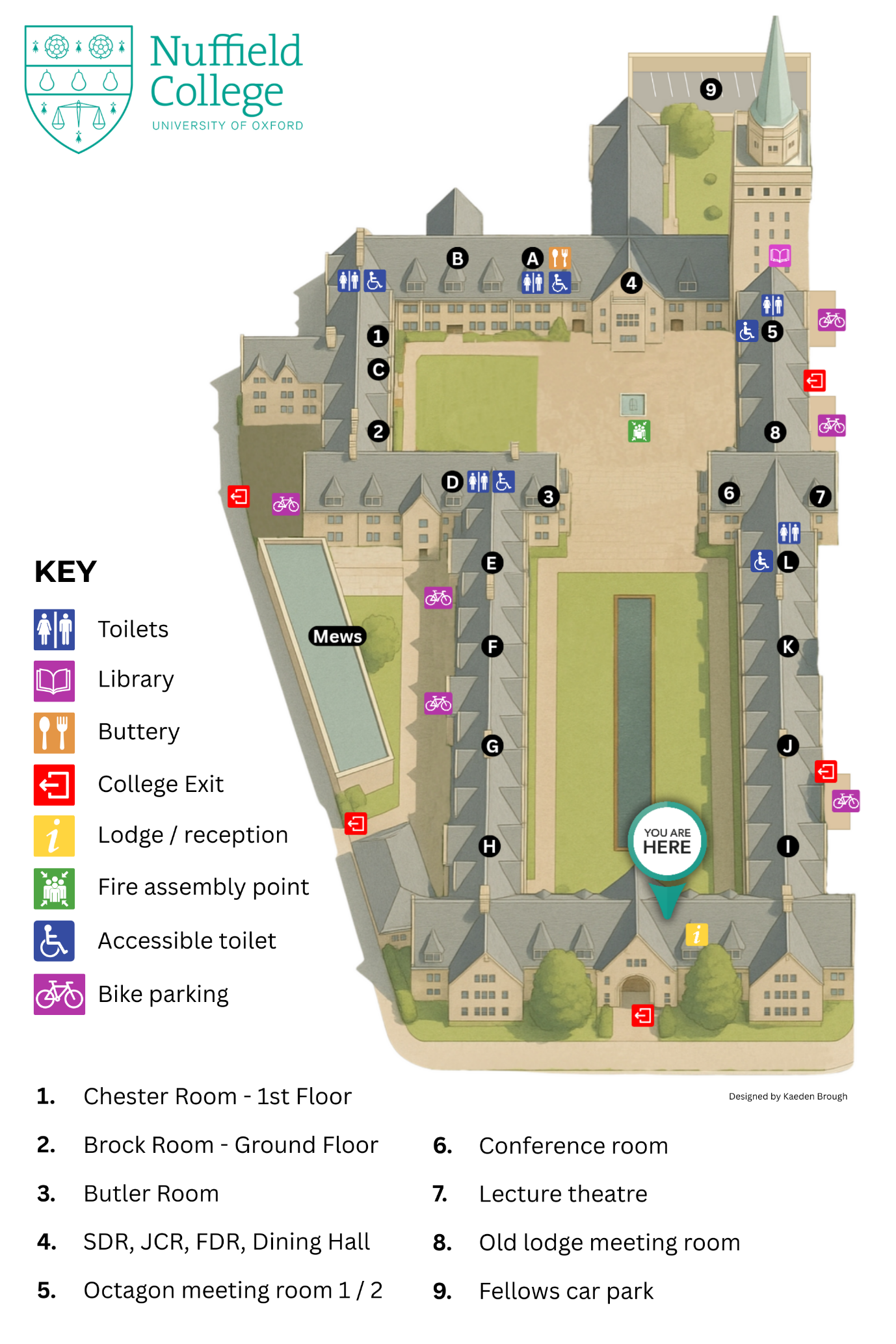
The Nuffield College map identifies the Worcester Street entrance and Porter's Lodge, conference rooms, toilets including accessible toilets, bicycle parking, exits and the fire assembly point.

From Oxford railway station

Walk east along Park End Street towards the city centre. After about five minutes, turn left onto Worcester Street. The College entrance is through the large gates on your right.

From Gloucester Green bus station

Leave towards George Street, walk west to Worcester Street, then turn left. The College entrance is through the large gates on your left.